Obsidian is loved for good reasons. Your notes are plain Markdown files on your own device, you link them together into a web of thoughts, and hundreds of community plugins let you turn it into almost anything. For people who enjoy building their own system, it is hard to beat.
Drift starts from the other end. It is made for creative people with a lot of thoughts who want everything in one place without building anything first. No folders to plan, no plugins to pick, no graph to tend. You open it and say what is on your mind.
When it comes to creativity, sometimes less is more.
The short answer
- Choose Obsidian if you want a linked knowledge base of your own, love tinkering with plugins and themes, or need Windows, Linux or Android.
- Choose Drift if you want to catch ideas the moment they arrive, mostly by voice, and have them sorted and grown into projects without setting anything up.
- Use both if Obsidian is where your research and reference notes live: catch and make in Drift, and keep your long-term notes in Obsidian.
Building a system vs having one
In Obsidian you decide how everything works: the folders, the links, the tags, the templates, the plugins that add tasks or calendars or boards. That freedom is the point, and some people spend happy evenings on it. Others notice that the system keeps growing while the ideas inside it wait.
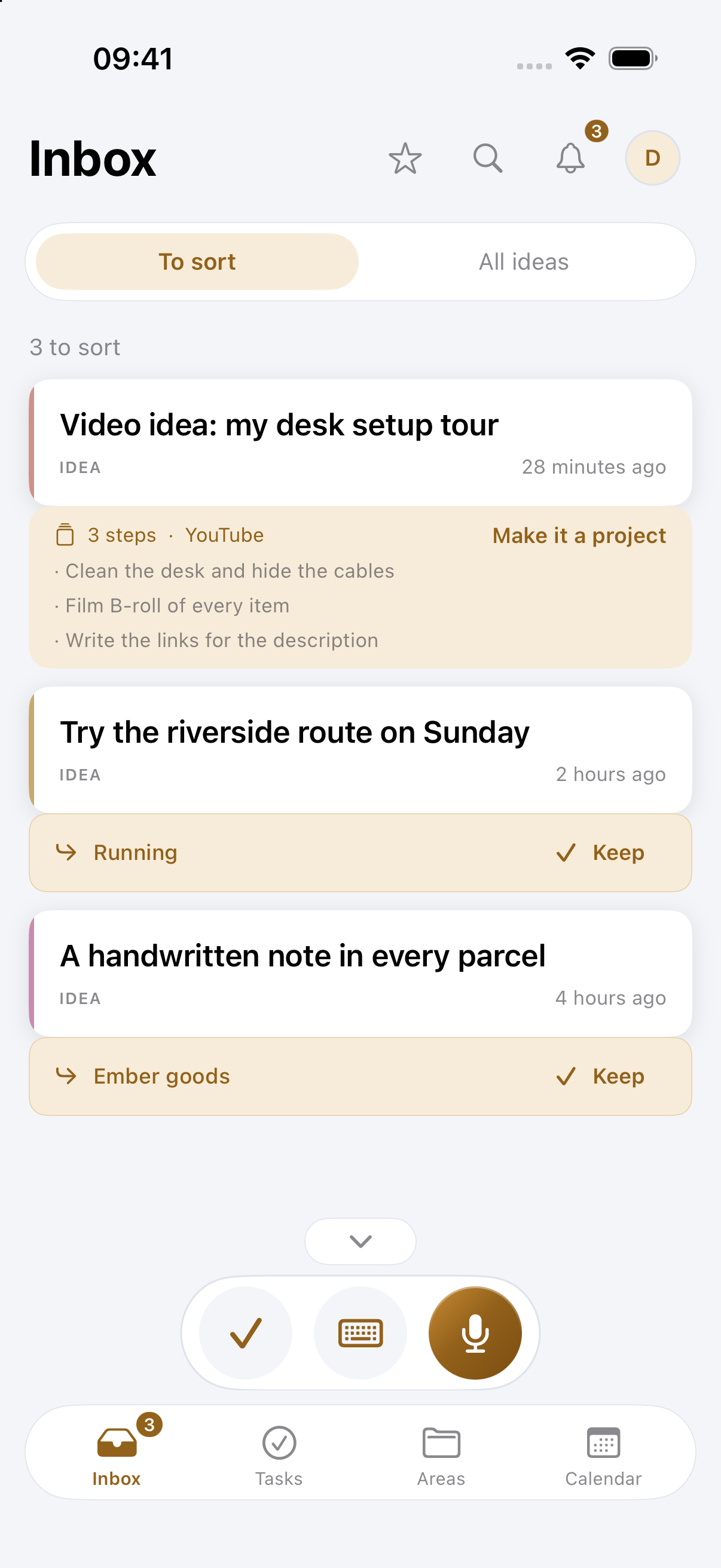
Drift comes with one simple system that stays the same. Your life is split into a few areas, like YouTube, Work or Home. Ideas land in one inbox, each with a title and a suggested area. Good ideas become projects. There is nothing to maintain, so the time goes into the work.
Catching an idea
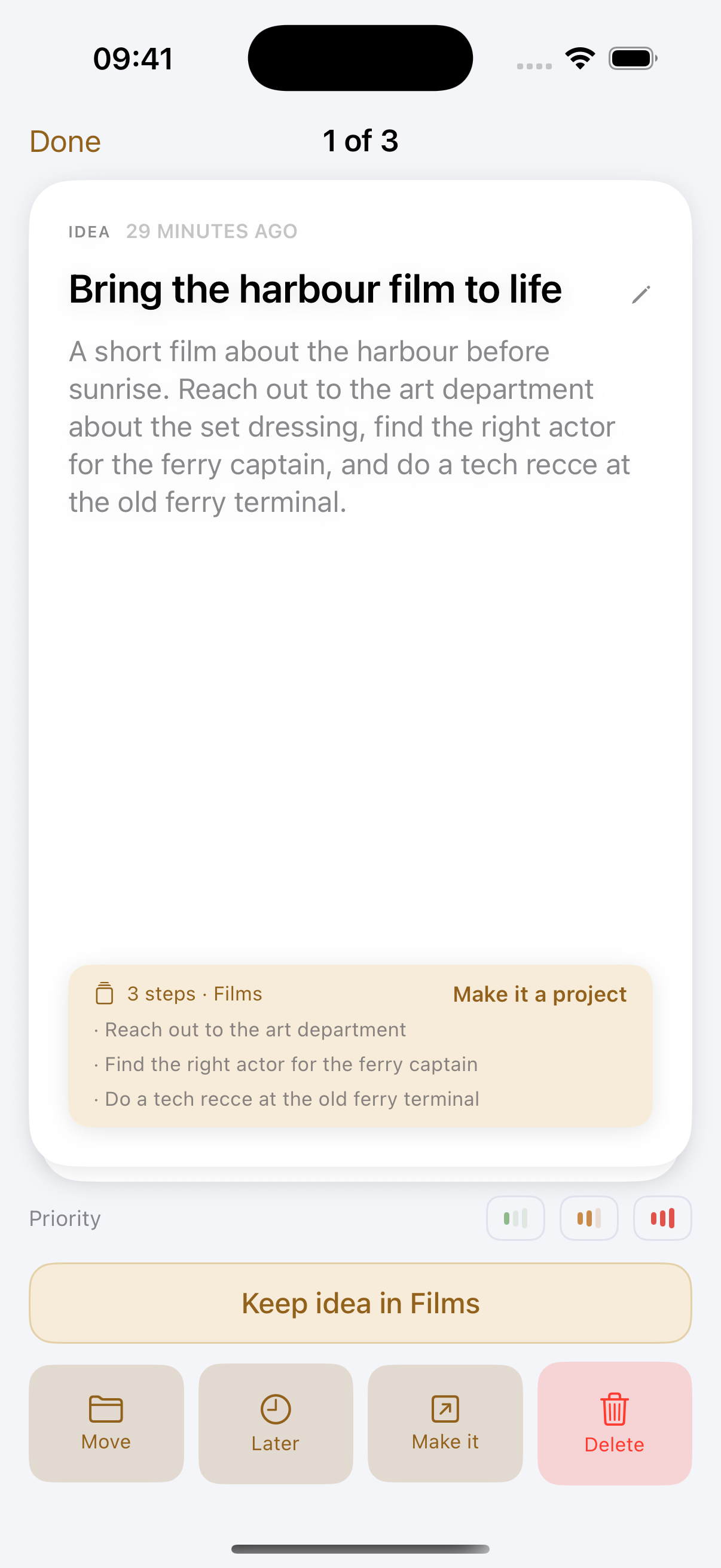
Obsidian is built for typing, at a desk, into a note you open first. Drift is built for the moment an idea arrives somewhere else. Talk from the app, a widget, the Action Button, Apple Watch, or say "Hey Siri, catch my drift". Drift keeps listening through pauses, writes it down, cleans it up, gives it a title and pulls out any tasks you mentioned. It works offline too.
Everything in one package
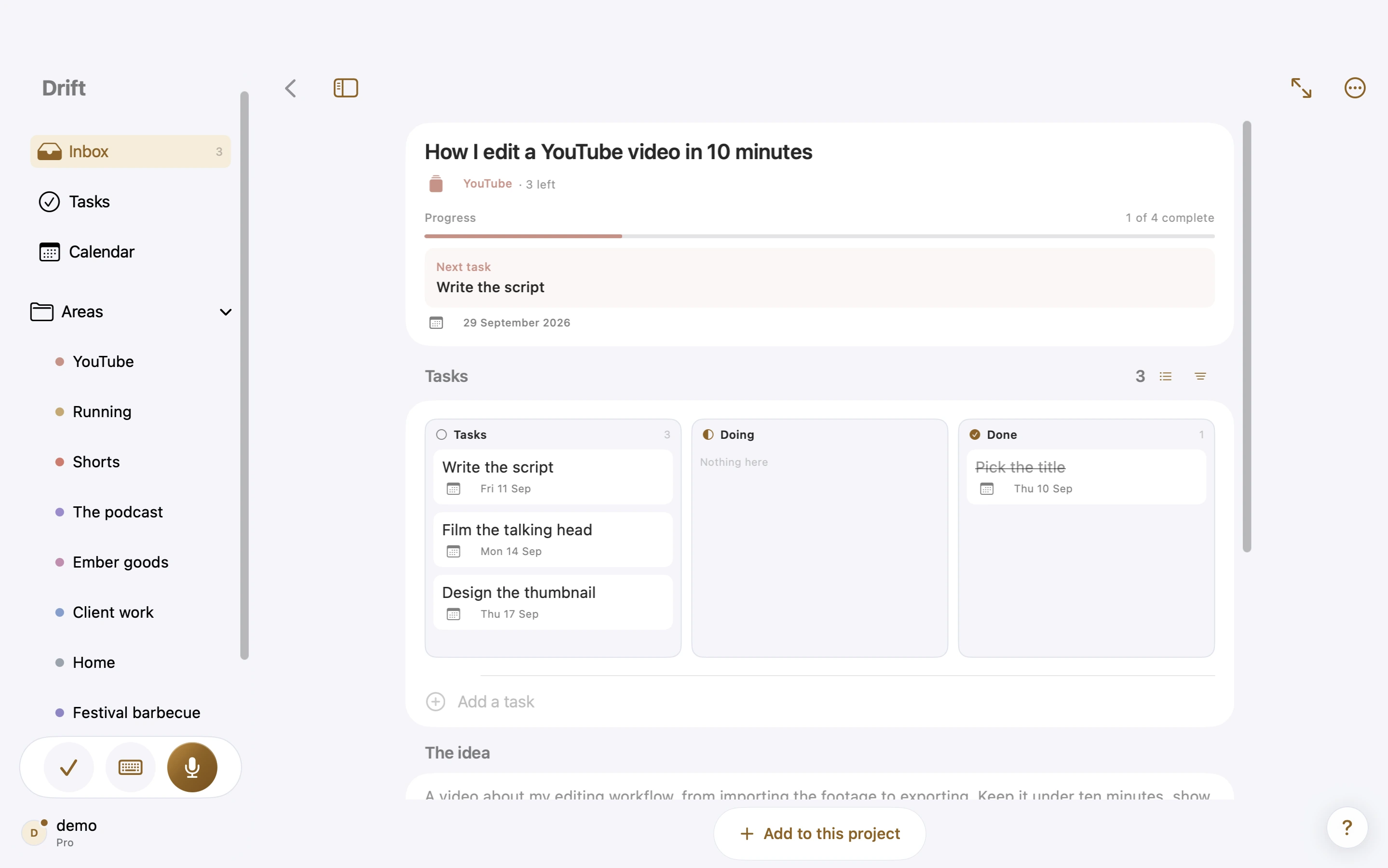
With Obsidian you add plugins for tasks, calendars, kanban boards and the rest, and keep them working together. Drift has those pieces built in and made to fit: tasks with reminders, a calendar, full-screen writing for scripts and outlines, a free-form board for images and notes, tables for shot lists or budgets, and a teleprompter that reads your script back to camera.
Where Obsidian is the better pick
- You want your notes as plain files on your own device, in a format you fully control.
- You want to link notes into a personal knowledge base and see how they connect.
- You enjoy shaping your tools with plugins, themes and scripts.
- You need Windows, Linux or Android today. Drift is on iPhone, iPad and Mac, with capture on Apple Watch.
Price
Obsidian is free to use, with paid add-ons for syncing between devices and for publishing notes as a website. Drift has a small free plan, and one Pro subscription covers iPhone, iPad and Mac with syncing included. The reason Drift is not free forever is below.
Drift at a glance
- iPhone, iPad and Mac, with capture on Apple Watch. Android, Windows and the web are planned for later.
- The app comes in 10 languages, and you choose the language you speak in separately: read Drift in Dutch and talk in English, or the other way round.
- Capturing works offline, on a plane or without signal, and syncs when you are back online.
- Search across everything you have caught, and add images to your projects and boards.
- Tasks sync with Apple Reminders both ways: tick a reminder and the task is done, add one to a Drift list and it becomes a task. Timed tasks go to Apple Calendar, and your calendar events show in Drift.
- Export your writing as Markdown, and tables as PDF or CSV.
- Share an area with someone, view-only or with editing, as part of Pro.
- Your account and ideas are stored in the EU, in Ireland.
- Pro starts with a 14-day free trial.
Full transparency
Obsidian is free to use, and Drift is not entirely. Drift is built and maintained by one person: Sjoerd, a filmmaker in Haarlem. The parts that make Drift feel easy, turning your voice into clean text, giving every idea a title and suggesting where it belongs, run on paid servers, so every capture costs real money. That is why Drift cannot be free forever.
There is a free plan so you can try it properly, but it is limited on purpose: 10 captures a week and up to 6 areas. Pro is €4.99 a month, or €47.90 a year, which works out at €3.99 a month. Pro starts with a 14-day free trial, so you can try everything before you pay. Low enough to be easy, and enough to keep Drift going and getting better.
And one promise that costs nothing: your ideas and writing are never used to train models.
Drift is on the App Store for iPhone, iPad and Mac, with capture on Apple Watch. Start with the free plan and see if it fits the way you think.